
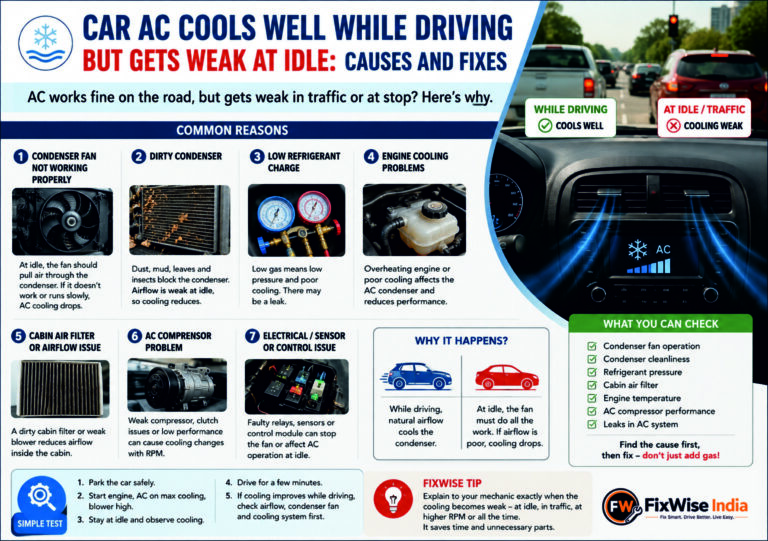
Have you noticed something strange with your car AC?
The AC cools properly when you are driving, but when you stop at a traffic signal or park with the engine running, the cooling suddenly becomes weak.
Then, as soon as you start driving again, the AC feels cold.
This is not normal AC behaviour. In many cases, the problem is related to airflow, condenser cooling, engine cooling, or AC pressure rather than the AC gas itself.
Here are the most common reasons and what you can check.
1. Condenser Fan Is Not Working Properly
Your car’s AC condenser needs airflow to remove heat from the refrigerant.
When the car is moving, plenty of air passes through the condenser naturally. But when the car is stationary, the condenser fan has to provide that airflow.
If the fan is not working, is running slowly, or starts only intermittently, the AC may cool well while driving but become weak at idle.
What you may notice
- AC becomes weak at traffic lights
- Cooling improves when you accelerate or start driving
- Engine temperature may also rise in some cases
- Fan may not run when the AC is switched on
What to check
With the engine running and AC switched on, check whether the cooling fan operates.
Do not put your hands near the fan. It can start suddenly.
If the fan does not operate, the problem could be a fuse, relay, wiring, fan motor, control module, or temperature/pressure signal.
2. Condenser Is Dirty
The condenser is normally located near the front of the radiator.
Over time, it can collect:
- Dust
- Mud
- Insects
- Leaves
- Road debris
A dirty condenser cannot release heat efficiently.
At higher speed, the increased airflow can partly compensate for this problem. At idle, however, the weak airflow can make the problem much more noticeable.
Simple check
Look through the front grille and see whether the condenser surface is heavily blocked with dirt.
If it is dirty, cleaning may improve AC performance.
However, avoid using extremely high-pressure water directly on the fins because they can bend easily.
3. AC Refrigerant Charge May Be Low
Low refrigerant can also cause poor cooling.
However, do not assume that low cooling automatically means the AC needs gas.
If refrigerant is low, there is usually a reason for it.
The system may have a leak.
Adding refrigerant without finding the leak may provide only temporary improvement.
A technician should check the system pressure and inspect for leakage before charging it.
4. Engine Cooling Problems Can Affect AC Performance
The AC condenser and engine radiator work very close to each other.
If the engine cooling system is struggling, the AC system can also be affected.
Check for:
- Cooling fan problems
- Low coolant level
- Blocked radiator/condenser
- Engine overheating
- Faulty thermostat
- Poor coolant circulation
If your engine temperature is also higher than normal, do not ignore it just because the AC is your main complaint.
5. AC Fan Speed or Blower Problem
Sometimes the AC system is actually producing cold air, but the air reaching the cabin is insufficient.
A partially blocked cabin air filter can reduce airflow.
You may notice:
- Weak air from the vents
- Good cooling only at higher blower speeds
- Reduced airflow compared with earlier
- Dust coming from the vents
A dirty cabin filter is relatively simple to inspect and replace.
6. AC Compressor Problem
The compressor is responsible for circulating refrigerant through the AC system.
If the compressor is becoming weak, AC performance may change depending on engine speed.
Possible symptoms include:
- Cooling changes with RPM
- Poor cooling at low engine speed
- Unusual compressor noise
- Compressor clutch repeatedly switching on and off
- AC performance gradually getting worse
Compressor problems should be diagnosed before replacing expensive parts.
A Simple Test You Can Do
If your AC is cold while driving but weak at idle, try this simple observation.
Step 1
Park the car safely outdoors.
Step 2
Start the engine.
Step 3
Set the AC to maximum cooling and high blower speed.
Step 4
Let the car remain stationary.
Step 5
Observe whether the AC cooling becomes weaker after several minutes.
Step 6
Now drive the car for a few minutes.
If the AC becomes noticeably colder while driving, condenser airflow and cooling should be among the first things checked.
This does not prove that the condenser fan is faulty, but it gives the technician a useful clue.
Should You Add AC Gas?
Not immediately.
This is one of the most common mistakes car owners make.
If the AC works well while driving but becomes weak at idle, the problem could be related to the condenser fan or airflow.
Adding refrigerant without checking the system can make diagnosis more difficult and, if the system is already correctly charged, can create another problem.
Ask the workshop to check:
- Refrigerant pressure
- Condenser airflow
- Cooling fan operation
- Condenser condition
- Cabin air filter
- Compressor operation
- AC system for leaks
When Should You Stop Driving?
If the AC problem is accompanied by engine overheating, take it seriously.
Turn off the AC and safely stop the vehicle if the engine temperature rises into the danger zone or you see an overheating warning.
Do not open a hot coolant reservoir.
An AC problem by itself is usually inconvenient. An engine cooling problem can become much more expensive if ignored.
Final Takeaway
If your car AC is cold while driving but weak when the car is standing still, don’t automatically blame the refrigerant.
The difference between driving and idling is an important clue.
When the car is moving, natural airflow helps cool the condenser. When the car stops, the cooling fan has to do much more of the work.
So, before spending money on an AC gas refill or compressor replacement, have the condenser, cooling fan and airflow checked first.
A small fan problem can sometimes make the entire AC system feel like it has failed.
FixWise India Tip: When explaining an AC problem to your mechanic, tell them exactly when the cooling becomes weak — at idle, in traffic, at higher RPM, or all the time. That information can save both time and unnecessary parts replacement.