
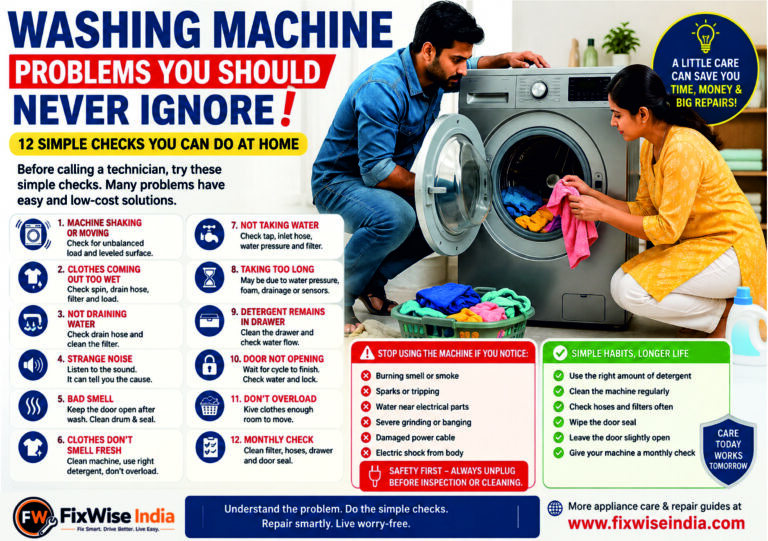
A washing machine usually works quietly in the background—until one morning it suddenly starts making a strange noise, leaves clothes soaking wet, refuses to drain, or begins shaking like it is trying to walk out of the house! 😄
The good news is that many washing-machine problems do not immediately mean that the machine needs a costly repair.
Sometimes the reason is surprisingly simple: an overloaded drum, a blocked drain filter, an unbalanced load, low water pressure, a closed tap, or even a small object stuck somewhere it shouldn’t be.
Before calling a technician, go through these checks.
1. Your Washing Machine Is Shaking or Moving
If your washing machine starts shaking heavily during the spin cycle, don’t ignore it.
The most common reason is an unbalanced load.
For example, washing one heavy bedsheet, blanket or towel along with a few lightweight clothes can cause the drum to become badly unbalanced.
Try this:
- Pause the machine.
- Open the door after it unlocks.
- Spread the clothes evenly.
- Remove a few heavy items if the drum is overloaded.
- Restart the spin cycle.
Also check whether the machine is standing firmly on the floor.
A washing machine should not rock when you push it gently from the corners.
2. Clothes Are Coming Out Too Wet
This is one of the most common complaints.
If the washing machine completes its cycle but clothes are still dripping wet, check:
First: Is the machine spinning properly?
Second: Is the drain hose blocked or bent?
Third: Is the drain filter clogged?
Fourth: Is the machine overloaded?
A machine cannot spin effectively if it cannot remove the water properly.
3. Washing Machine Is Not Draining Water
If you open the machine after the cycle and find water sitting inside the drum, don’t immediately assume that the drain pump has failed.
First check the drain hose.
Look for:
- Kinks
- Blockages
- Incorrect hose positioning
- Dirt or objects blocking the outlet
Then check the drain filter if your model has an accessible filter.
Coins, hair clips, buttons, threads and small pieces of cloth can sometimes collect there.
⚠️ Always switch OFF and unplug the washing machine before checking or cleaning anything near the pump or electrical components.
4. Washing Machine Is Making a Strange Noise
Not every noise means the motor is damaged.
Listen carefully.
🔊 Clicking sound
A coin, button or other small object may be trapped somewhere.
🔊 Loud banging
The load may be badly unbalanced.
🔊 Grinding sound
This deserves more attention and may indicate a mechanical problem.
🔊 Humming but drum not moving
There could be a problem with the motor, capacitor, drive system or something mechanically stuck, depending on the machine design.
The sound itself can often give you the first clue.
5. Washing Machine Has a Bad Smell
This is especially common when the machine is used frequently but the door remains closed after washing.
Moisture remains trapped inside the drum, rubber gasket, detergent drawer and other areas.
Over time, detergent residue, dirt and moisture can create an unpleasant smell.
Simple habit:
After every wash:
Leave the door slightly open.
Also wipe the rubber door seal occasionally, particularly in front-load machines.
And don’t keep pouring extra detergent thinking that more detergent means cleaner clothes.
Sometimes too much detergent creates more residue rather than better cleaning.
6. Clothes Don’t Smell Fresh After Washing
This can be caused by several things:
- Dirty washing machine
- Excess detergent
- Clothes left inside for too long
- Low-temperature washing for long periods
- Dirty detergent drawer
- Poor drainage
A washing machine also needs cleaning.
Remember:
A machine that cleans your clothes also needs to be cleaned.
7. Washing Machine Is Not Taking Water
Before calling anyone, check the simplest things.
Check:
✔ Is the water tap ON?
✔ Is the inlet hose bent?
✔ Is there sufficient water pressure?
✔ Is the inlet filter blocked with dirt?
✔ Is the door properly closed?
If all these are fine and the machine still doesn’t take water, then the problem may involve the inlet valve, control system or another component.
8. Washing Machine Is Taking Too Long
Modern washing machines can sometimes take much longer than people expect.
A longer cycle doesn’t automatically mean something is wrong.
However, if the machine keeps filling and draining repeatedly, or appears stuck at one stage, investigate further.
Possible reasons include:
- Poor water pressure
- Drain hose installation problem
- Excessive foam
- Drainage restriction
- Sensor or control problem
9. Detergent Is Remaining in the Drawer
If detergent remains in the dispenser after the wash, don’t simply add more detergent.
First clean the drawer.
Also check whether water is entering the dispenser properly.
Using excessive detergent can actually make the situation worse by creating residue.
10. The Door Is Not Opening
This can be frightening when you have clothes and water trapped inside.
But don’t force the door open.
The door may remain locked because:
- Water is still inside.
- The cycle has not completely finished.
- The machine has not released the door lock yet.
- There is a fault in the locking system.
Wait for the machine to finish its safety release process.
If water remains inside, the drainage problem should be addressed first.
11. Don’t Overload Your Washing Machine
This is one mistake that many households make.
The drum may look large enough to hold more clothes, but washing capacity is not simply about whether clothes physically fit inside.
A heavily overloaded drum can result in:
- Poor washing
- Poor rinsing
- Poor spinning
- More vibration
- Greater stress on mechanical components
Give the clothes enough room to move.
12. The Most Important Habit: Give Your Washing Machine a Monthly Check
You don’t need to wait until something breaks.
Once a month, spend just 10–15 minutes checking:
🛠️ Washing Machine Quick Check
1. Clean the detergent drawer.
2. Check the rubber door seal.
3. Check the drain filter.
4. Inspect the inlet and drain hoses.
5. Look for unusual vibration.
6. Listen for new or unusual sounds.
7. Clean the machine according to the manufacturer’s instructions.
8. Keep the door slightly open after use.
These simple habits can help you notice problems before a small issue becomes an expensive repair.
🚨 When Should You Stop Using the Machine?
Some problems should not be treated as DIY repairs.
Stop using the washing machine and disconnect it from power if you notice:
- Burning smell
- Smoke
- Sparks
- Water reaching electrical connections
- Repeated electrical tripping
- Severe grinding or banging
- Damaged power cable
- Electrical shock/tingling from the machine body
In these situations, don’t keep restarting the machine to see if it works.
Safety comes first.
🏠 One Small Lesson Every Homeowner Should Know
You don’t need to become a washing-machine technician.
But you should know your appliance well enough to recognise the difference between a simple problem and a serious one.
A blocked filter can be cleaned.
An unbalanced load can be corrected.
A bent hose can be repositioned.
But an electrical fault, damaged wiring or serious mechanical problem is better left to a qualified technician.
Before you spend money on a repair, spend five minutes understanding the problem.
That simple habit can save money, time and unnecessary frustration.
More practical appliance-care and repair guides are coming
on
FixWiseIndia.com.